The Setup
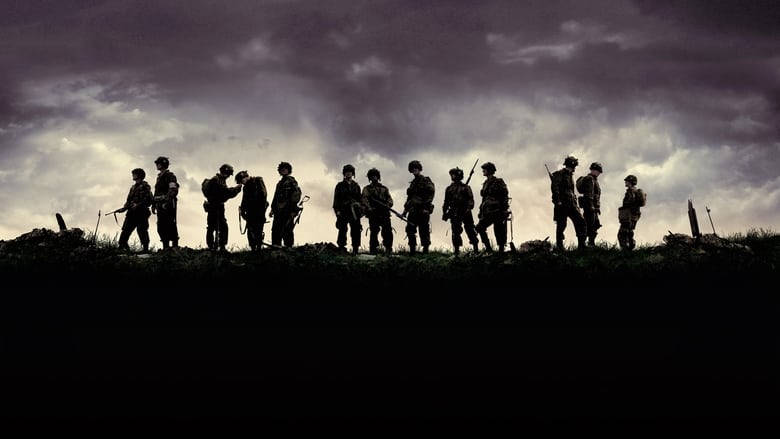
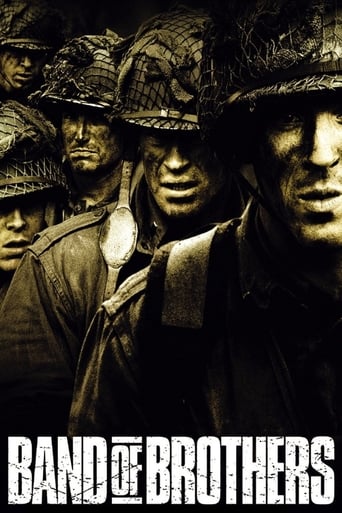
Ten episodes on HBO from 2001, executive produced by Steven Spielberg and Tom Hanks, adapted from Stephen Ambrose's book about Easy Company, 506th Parachute Infantry Regiment, 101st Airborne. The opening hour, "Currahee," runs the paratroopers through jump school in Georgia under a preening martinet of a company commander, and introduces the officer the show quietly builds itself around: Lieutenant Dick Winters, played by Damian Lewis in the role that put him on the map. By hour two they're jumping into Normandy. From there the series follows the same unit through the European theater, with Ron Livingston as the sardonic intelligence officer Nixon, Donnie Wahlberg as Lipton, Scott Grimes as Malarkey, and a bench of then-unknowns that includes Michael Fassbender, James McAvoy, Tom Hardy, and Simon Pegg in small parts.
What It Gets Right
The infantry-level detail is the whole thing. Every episode opens with real veterans of Easy Company speaking to camera, unnamed until the finale, and that framing gives the dramatization a weight the genre almost never earns. Damian Lewis plays Winters with a quiet Presbyterian competence that never tips into hero worship; he's a good officer who finds combat clarifying and is unnerved by that fact. The direction rotates episode to episode (Phil Alden Robinson, Mikael Salomon, David Nutter, Tom Hanks himself on "Crossroads," David Leland on the medic hour) but the visual grammar stays consistent: cold color, handheld inside the treeline, wide static shots for the aftermath. The sound design of the Normandy jump and the Bastogne artillery is still the reference point twenty-five years later.
What It Gets Wrong
It's a hagiography. Ambrose was already accused of sanding the rough edges off Easy Company, and the show inherits that. Almost every character is brave, decent, and reflective; the moral texture of a real infantry unit isn't really the project here. The middle stretch has a serious Replacement Problem, where the show introduces named faces you're supposed to feel something for and can't quite tell apart under the helmets. And the "great man" episodes about Winters and Speirs land harder than the ensemble hours by a margin the writing never really closes.
Who It's For, Who'll Bounce
If you liked Saving Private Ryan and wanted forty more hours of that texture, this is the definitive version. Fans of Generation Kill and The Pacific will already know where it sits on the shelf. If you want war fiction with more ambivalence about the men fighting it, closer to Come and See or The Thin Red Line, you'll find this one tidy. Anyone who bounces off military jargon, roll-call scenes, and long stretches of men digging holes should probably skip it.
Final Word
WORTH IT because the craft is still the ceiling for the genre and the show mostly earns its reverence through specificity rather than speeches. When it does reach for a Message, it's usually delivered by a real veteran in a talking-head cutaway rather than by a character monologuing at the audience, which is the right call and the reason the sentimentality doesn't curdle. The politics of the thing, insofar as it has any, are baked into Ambrose's frame: these men were good, the cause was just, don't overthink it. Whether that reads as honest or as flattering depends on you, but the show isn't lecturing; it's presenting. Twenty-five years on, the Bastogne hour alone justifies the tier.